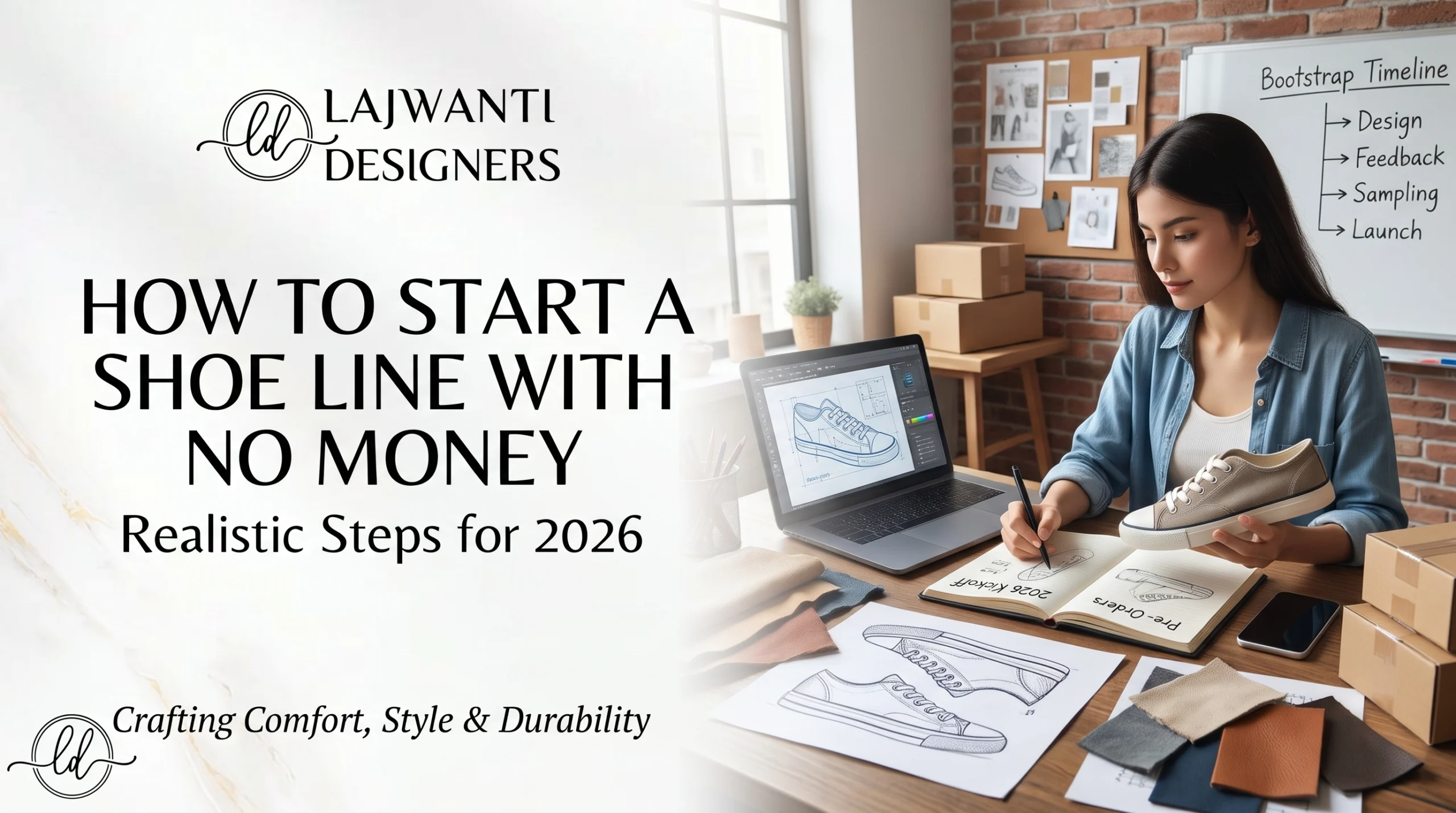
Starting a shoe line with no money is not impossible, but it requires a clear-eyed understanding of what “no money” actually means in footwear manufacturing. You cannot produce shoes without paying for samples, materials, and production. What you can do is start with a very small amount of capital, validate demand before committing to inventory, and use a low-MOQ manufacturing partner to keep your first order within reach. This guide lays out the realistic path for 2026, written for founders who have more determination than budget.
The core principle is simple: do not spend money on anything that does not directly move you toward a sellable product. That means no expensive website, no flashy branding agency, no trade show booth, and no bulk inventory before you have proven that someone will buy. Instead, focus on a sample, a small first production run, and a sales channel that costs nothing to set up. You can review the women’s shoes manufacturing page to understand what a low-MOQ factory actually offers before you spend a single rupee on design tools or marketing.
What “No Money” Really Means in Footwear
Let us be direct. You cannot start a shoe line with literally zero rupees. Samples cost money. Materials cost money. Production costs money. What you can do is start with a small, controlled budget—often a few hundred dollars rather than tens of thousands—by making smart choices about what you spend on and what you delay.
The founders who succeed with limited capital are the ones who treat every expense as a test. A sample is not a cost; it is a validation step. A small first order is not inventory; it is proof that the product sells. A simple website is not a brand statement; it is a place to collect orders. When you frame spending this way, the question changes from “How do I get money?” to “What is the smallest amount I can spend to learn whether this idea works?”
Lajwanti Collections, a B2B manufacturer in Lahore that has operated since 2003, structures its women’s footwear MOQ at 12 pairs per design, per colour . For a founder testing a single design in a single colour, that is a manageable first commitment—far smaller than the hundreds or thousands of pairs that traditional factories require. The factory also offers paid sample development, typically completed in 10–14 days after specifications are confirmed, followed by bulk production in 4–6 weeks after approval . This timeline means you can move from idea to a physical sample quickly, without tying up capital in inventory before you know whether the design resonates.
Step 1: Validate Before You Create
The biggest mistake first-time founders make is designing a full collection before confirming that anyone wants it. With no money, you cannot afford to produce ten styles and hope one sells. You need to test demand before you spend on samples.
Validation does not require a product. It requires a conversation. Talk to potential customers—boutique owners, online sellers, friends who fit your target market—and ask what they actually need. Not what they think is interesting, but what they would pay for. A boutique owner who stocks heels will tell you which heel heights sell and which sit on the shelf. An online seller will tell you which sizes are requested most. This information is free, and it is more valuable than any trend report.
You can also use social media to test interest before production. Post a sketch or a reference image and see what response you get. Ask followers whether they would buy a shoe in a specific style. This is not a perfect predictor, but it costs nothing and it forces you to articulate your idea clearly. If you cannot explain why someone would buy your shoe in two sentences, you are not ready to spend money on a sample.
Step 2: Choose a Manufacturing Route That Fits Your Budget
There are three practical routes for a founder with limited capital, and each has different cost implications.
Catalog customization (ODM-style): You start from an existing manufacturer design and change approved details—colour, material, branding, packaging. This route reduces development costs because the construction is already proven. Lajwanti Collections offers this route for buyers who want to move quickly without building a design from scratch .
Private label development: You develop a product sold under your own brand, including design refinement, material selection, sampling, and logo application. This requires more development work than catalog customization but gives you more control over the final product .
OEM manufacturing: You provide a tech pack, reference sample, or developed design, and the factory produces against your specification. This is the most demanding route and assumes you already know exactly what you want .
For a founder with no money, the catalog customization route is usually the most realistic starting point. It lets you launch a branded product without paying for full design development. Once you have proven that the product sells, you can invest in more custom development for your second collection.
Step 3: Get a Sample Before You Commit to Production
A physical sample is the single most important investment you will make. It is the only way to confirm fit, construction, materials, and finish before you commit to a bulk order. Skipping the sample stage to save money is a false economy; a production run based on an unproven design is far more expensive than a paid sample.
At Lajwanti Collections, sample development is a paid stage, typically completed in 10–14 days after the design and specifications are confirmed . The sample is your reference point for bulk production—what you approve is what you should receive. Treat the sample cost as a validation expense, not an overhead. If the sample is wrong, you have lost a small amount of money. If you skip the sample and the bulk order is wrong, you have lost the entire production budget.
When the sample arrives, test it honestly. Wear it. Ask someone in your target market to wear it. Check the fit across sizes if you can. Look at the stitching, the sole attachment, and the finish. A sample that looks good in photos but feels wrong in person is a warning sign.
Step 4: Start with the Smallest Possible Order
The traditional footwear manufacturing model requires hundreds or thousands of pairs per style. This is impossible for a founder with no money. The alternative is a low-MOQ manufacturer that allows you to start with a small batch and scale only after you have sales data.
Lajwanti Collections’ verified MOQ for women’s footwear is 12 pairs per design, per colour . For a founder launching a single style in a single colourway, that is a first order of 12 pairs—a commitment that is within reach for most bootstrapped founders. If you want to offer multiple sizes, you can structure the 12 pairs across your size range. If you want to test two colours, you can order 12 pairs per colour, which doubles the order but gives you more data.
The goal of the first order is not to make a profit. It is to prove that the product sells and to learn what customers actually want. A small first order gives you real feedback: which sizes sell out, which colours move, what customers say when they receive the product. That information is worth more than the margin on a larger order you cannot afford.
Step 5: Build a Sales Channel That Costs Nothing
You do not need a custom website to sell your first pairs. You need a place where people can see the product and pay for it. In 2026, the lowest-cost options are social media and marketplace platforms.
Instagram and TikTok are free to use and allow you to show the product in motion—something static product photos cannot do. A short video of the sample being worn, with a clear description of the materials and sizing, is often more effective than a polished product page. WhatsApp Business is free and widely used for order inquiries in many markets, including Pakistan, the UAE, and parts of Europe. You can share photos, confirm sizing, and arrange payment directly.
If you want a more formal storefront, a basic Shopify or WooCommerce site can be set up for a low monthly cost, but this is not necessary for the first few orders. The priority is to sell the pairs you have, not to build a brand experience. Once you have revenue, you can invest in a better website.
Step 6: Reinvest Revenue into the Next Order
The bootstrapping model works only if you treat the first order as a cycle, not a one-time event. When the first 12 pairs sell, use the revenue to fund the next order. This might mean ordering the same design again if it sold well, or testing a new design if the first one did not resonate. The key is to keep the cycle moving: order, sell, learn, order again.
Lajwanti Collections offers a structured process from brief to shipping: you share your product requirements, the team reviews feasibility and confirms pricing and sample costs, you approve a paid sample, and bulk production begins after approval . This process is designed to be repeatable, so your second order is faster and smoother than the first. Over time, as your order volume grows, you can negotiate better terms and expand your range.
Common Mistakes to Avoid
Spending on branding before you have a product. A logo and a brand name are not a shoe line. Do not pay a designer or an agency before you have a sample you believe in.
Ordering too many sizes or colours in the first run. Every additional size and colour increases your order quantity and your risk. Start with the smallest range that makes sense for your market and expand after you have sales data.
Skipping the sample to save money. A bad bulk order is far more expensive than a paid sample. The sample is your insurance policy.
Assuming a low MOQ means low quality. A factory that offers 12-pair minimums is not necessarily cutting corners. It is structuring its production to serve smaller buyers. The quality depends on the factory’s standards and your sample approval, not the order size.
Working with Lajwanti Collections
Lajwanti Collections is a direct B2B manufacturer based in Lahore, Pakistan, producing women’s footwear for brands, boutiques, and wholesalers worldwide. The company has manufactured since 2003 and offers private label, OEM, and catalog customization routes with a verified MOQ of 12 pairs per design, per colour . Paid samples are typically developed in 10–14 days, and bulk production typically takes 4–6 weeks after sample approval . An NDA is available on request for founders who need to protect their designs.
If you are ready to start, the first step is to review the women’s shoes manufacturing page and prepare a brief with your product type, reference design or sketch, quantity, materials, colours, sizes, branding, and destination country. The more detail you provide, the faster the factory can confirm feasibility and provide a quotation.
Conclusion
Starting a shoe line with no money is not about finding a free factory or a magic supplier. It is about spending the smallest possible amount to validate your idea, produce a sample, and make a first sale. The founders who succeed are the ones who treat every expense as a learning opportunity and every order as a step toward the next one. With a low-MOQ manufacturer and a disciplined approach to spending, you can launch a real footwear product in 2026 without a large budget—just a clear idea and the willingness to start small.
FAQs
Can I really start a shoe line with no money?
You cannot start with literally zero money because samples and production cost money. But you can start with a small, controlled budget by choosing a low-MOQ manufacturer, starting with a single design, and selling before you scale. The goal is to minimize the initial spend, not eliminate it entirely.
What is the minimum order for women’s shoes at Lajwanti Collections?
The verified MOQ for women’s footwear is 12 pairs per design, per colour . This allows founders to test a design without committing to hundreds or thousands of pairs.
Do I need a tech pack to start?
No. You can start from an existing Lajwanti Collections design and customize approved details, or submit a sketch, reference photo, or mood board for review. A full tech pack is helpful for OEM projects but is not required to begin the conversation .
How long does a sample take?
Paid sample development for women’s footwear is typically 10–14 days after the design and specifications are confirmed .
How long does bulk production take?
Bulk production is typically completed in 4–6 weeks after sample approval, subject to the design, materials, quantity, and production schedule .
Can I put my own logo on the shoes?
Yes. Lajwanti Collections supports private label branding, including logo placement on insoles, outsoles, labels, and packaging, depending on the design and materials .
Do I need to pay for samples?
Yes. Sample development is a paid stage confirmed during quotation. The sample is your reference for bulk production, so it is an investment in getting the product right before you commit to a larger order .
What if the first design does not sell?
Use the first order as a learning step. If the design does not sell, you have lost a small amount of money and gained information about what your market does not want. Adjust the design or the target market for the next order.