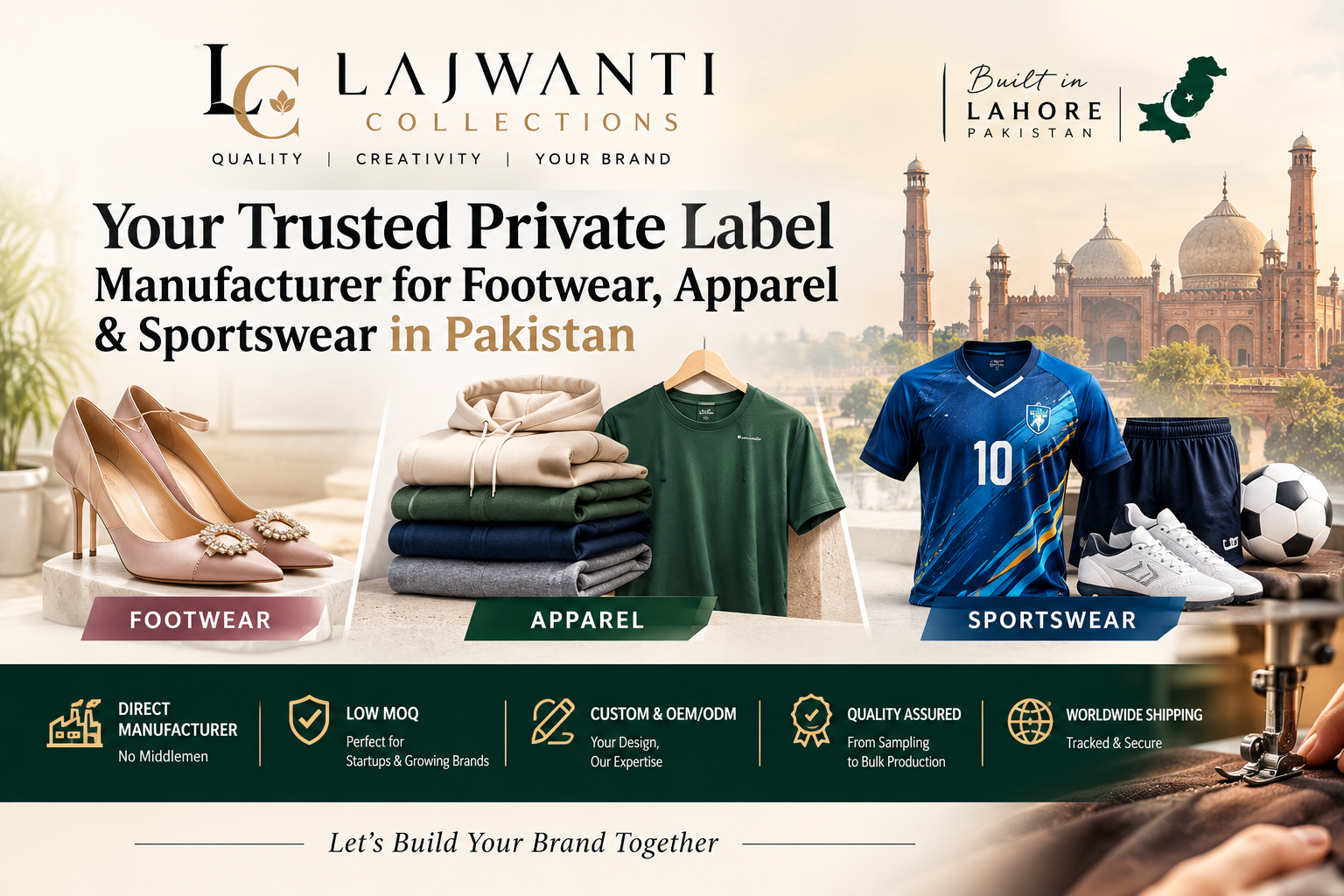
Lajwanti Collections is a B2B private label manufacturer based in Lahore, Pakistan, producing custom women’s footwear, private label apparel and sports uniforms for brands, wholesalers, importers and teams worldwide. The company has manufactured since 2003 and offers private label, OEM, ODM-style and fully custom development routes with low minimum order quantities, sample approval before bulk production, NDA protection and worldwide tracked shipping.
Who Is Lajwanti Collections?
Lajwanti Collections is a private label manufacturer, OEM manufacturer and custom product development partner headquartered in Lahore, Pakistan. Many buyers discover the company while searching for “Lajwanti,” “Lajwanti Collection” or “Lajwanti Designers” — the creative and development side of the business that works alongside the main manufacturing operation. The brand is also known simply as Lajwanti PK or Lajwanti Official, and all of those names point to the same Lahore-based production facility.
Unlike a trading company or a sourcing agent, Lajwanti Collections works as a direct B2B manufacturer. Core operations such as cutting, stitching, lasting, assembly, finishing and packing are handled inside the facility, while selected decoration processes — printing, embroidery and sublimation — are completed through trusted specialist vendors. This hybrid structure keeps quality control tight while still offering buyers a wide range of finishes.
The company has been manufacturing since 2003. That history matters in an industry where buyers regularly deal with middlemen who disappear after the deposit clears. A two-decade track record in Lahore’s manufacturing sector means the team has handled repeat orders, seasonal collections, private label rollouts and custom one-off prototypes across dozens of product types.
What Does Lajwanti Collections Manufacture?
Lajwanti Collections manufactures across three main product areas, all running through the same quotation and sample-approval process.
1. Women’s Footwear
Women’s footwear is the company’s largest manufacturing focus. Nine categories are available for private label, OEM and custom development: block heels, bridal shoes, flats, high heels, medium heels, platform shoes, pumps, sandals and wedges. Each category supports customisation of materials, colours, heel construction, sizing, logo placement, embellishments and packaging.
You can explore the full range on the Women’s Shoes page, where each category has its own dedicated section for buyers who want to start from an existing design or submit their own reference.
2. Private Label Apparel
The apparel division produces custom clothing for brands and B2B buyers. Apparel manufacturing supports low-MOQ runs, branding, labelling and packaging requirements confirmed per brief. Product types include tracksuits, jackets, T-shirts and other casual and fashion apparel built to buyer specification.
Full details are available on the Apparel Manufacturers page.
3. Custom Sports Uniforms
The sportswear division develops teamwear and jerseys for clubs, schools, organisations and private label buyers. Sports uniforms are built around approved colours, sizing, branding and fabric requirements. Categories include tennis uniforms, track uniforms, basketball uniforms, soccer uniforms, lacrosse uniforms, running jerseys, American football uniforms and baseball uniforms.
Private Label, OEM, ODM — What Is the Difference?
Buyers often use these terms interchangeably, but they describe different levels of involvement. Lajwanti Collections offers all four routes.
Private Label: Your approved product is manufactured under your brand, with project-specific labels, logos and packaging. You own the brand identity; the factory handles production.
OEM Manufacturing: Production follows the buyer’s approved design, reference or technical specification after development and sample approval. You bring the design; the factory builds it.
ODM-Style Development: Buyers may begin from an existing Lajwanti Collections design and customise the approved product, material, colour, branding and packaging details. This is the fastest route for founders who don’t yet have a full technical drawing.
Custom Development: A fully bespoke route where the product is developed from scratch against a brief, sketch, mood board or reference sample.
Most first-time buyers start with ODM-style or custom development, then move into private label or OEM once the product is validated and repeat orders begin.
Low MOQ Manufacturing for Startup Brands
One of the biggest barriers for new footwear and apparel brands is minimum order quantity. Traditional factories often require hundreds or thousands of units per style, which is impossible for a brand that hasn’t tested the market yet.
Lajwanti Collections is built to be accessible to smaller buyers. The company supports low-MOQ and small-batch production so a startup brand can validate a design, test demand and gather customer feedback before committing to a larger run. Exact minimums depend on the product, the materials and the level of customisation, and they are confirmed during quotation.
This approach is especially useful for:
First-time footwear founders launching a single style
Ecommerce sellers testing a new category
Boutique brands adding a small capsule collection
Sports clubs ordering teamwear for one season
Corporate buyers needing branded uniforms in limited numbers
Because sampling is a separate, paid step, buyers can approve the physical product before paying for bulk production. That reduces risk significantly.
The Six-Step Manufacturing Process
Every project — whether it’s a single pair of heels or a full teamwear order — follows the same structured path.
Step 1 — Brief: The buyer submits the product type, reference or design file, quantity, materials, sizes, branding, packaging and destination market.
Step 2 — Feasibility & Quotation: The team reviews feasibility, flags any missing specifications and confirms project-specific commercial terms.
Step 3 — Sample Development: A physical sample or prototype is developed against the confirmed specification. This is where construction, fit, colour and finish are tested.
Step 4 — Approval: The buyer reviews the sample and approves any required revisions. Nothing moves to bulk until this step is signed off.
Step 5 — Bulk Production & QC: Production follows the approved sample and specification, with quality checks applied before packing.
Step 6 — Packing & Worldwide Dispatch: Final packing is inspected and the agreed tracked-shipping arrangement is prepared for dispatch.
This sequence exists for one reason: to remove surprises. Buyers who have been burned by factories that “adjust” specifications mid-production tend to appreciate the sample-first approach.
Quality Control and Confidentiality
Quality control at Lajwanti Collections covers the checkpoints that actually affect a finished product:
Material inspection before cutting
Size and measurement verification
Stitching and finishing inspection
Logo, print, embroidery and decoration checks
Final packing inspection
The scope of QC is matched to the approved product, so a simple flat shoe and a heavily embellished bridal heel are not inspected against the same checklist.
Confidentiality is handled with equal seriousness. An NDA is available on request, and buyer designs, logos and files remain confidential. Product and project photographs are not published without buyer permission — an important point for brands protecting an unreleased collection.
Payment and Shipping
Payment terms are confirmed during quotation. Approved methods include Western Union, MoneyGram, Remitly and bank wire transfer, with exact instructions supplied per project.
Shipping is worldwide and tracked. Shipment insurance can be arranged on request. Freight, export documentation, customs responsibilities, duties and taxes are confirmed per order, which means buyers know their landed-cost responsibilities before production starts rather than after dispatch.
Sharing the destination market early in the conversation helps the team plan packaging, freight and documentation correctly from the beginning.
Who Does Lajwanti Collections Manufacture For?
The company works with a wide range of B2B buyers:
Startup Brands — use sampling and low-MOQ options to validate a product before scaling.
Established Brands — develop new product lines from approved designs, references or technical files.
Wholesalers & Importers — source branded footwear, apparel or uniforms with order-specific packing and shipping.
Retailers & Ecommerce Businesses — create branded ranges for stores, marketplaces or direct-to-consumer channels.
Sports Clubs & Teams — develop teamwear around approved colours, sizing, branding and fabric requirements.
Corporate & Institutional Buyers — discuss custom apparel, uniforms or branded products through a structured RFQ.
Each of these buyer types has a different priority. A startup cares about MOQ and sampling cost. An established brand cares about consistency and repeatability. A sports club cares about sizing ranges and delivery dates. The quotation process is designed to surface those priorities early.
Why Buyers Choose Lajwanti Collections
There are several practical reasons brands return to Lajwanti Collections rather than switching suppliers each season.
Manufacturing history since 2003. Two decades of production experience in Lahore’s manufacturing sector.
Direct factory relationship. Core operations are handled in-house, which reduces miscommunication and improves accountability.
Multiple product categories. Footwear, apparel and sportswear under one quotation process — useful for brands that want a single supplier across categories.
Sample approval before bulk. Buyers see and approve a physical prototype before committing to production.
NDA available. Confidential designs stay confidential.
Worldwide tracked shipping. With insurance available on request.
Structured communication. Clear briefs in, clear quotations out, fewer back-and-forth emails.
Frequently Asked Questions
Is Lajwanti Collections a private label and OEM manufacturer?
Yes. Lajwanti Collections operates as a private label manufacturer, OEM manufacturer, ODM-style development partner and custom manufacturer for footwear, apparel, sportswear and uniforms.
Can I submit my own design or tech pack?
Yes. Send a sketch, photo, reference sample, mood board or tech pack for feasibility review and a project-specific quotation. A finished tech pack helps, but it is not required to start.
Can I review a sample before bulk production?
Yes. A physical sample or prototype is developed against the confirmed specification, and bulk production begins only after sample approval.
Does Lajwanti Collections offer low MOQ manufacturing?
Yes. Low-MOQ and small-batch production is supported so startup brands can test a design before scaling. Exact minimums are confirmed per product during quotation.
Do you offer embroidery, printing and sublimation?
Yes. Selected printing, embroidery and sublimation are completed through trusted specialist vendors according to the project.
Can I request an NDA before sharing a confidential design?
Yes. An NDA is available on request.
What should I send for a manufacturing quote?
Product or category, design or reference file, approximate quantity, materials, colours and sizes, branding and packaging requirements, destination market and required date.
Does Lajwanti Collections ship worldwide?
Yes. Worldwide tracked shipping is available, with insurance on request. Export documentation, freight, customs responsibilities, duties and taxes are confirmed per order.
How to Start Your Project with Lajwanti Collections
Starting a manufacturing project is straightforward. Send a clear brief that includes:
Product or category
Design or reference file
Approximate quantity
Materials, colours and sizes
Branding and packaging requirements
Destination market and required date
The team will respond with pricing, MOQ details and a production timeline within 24 to 48 hours. There is no obligation.