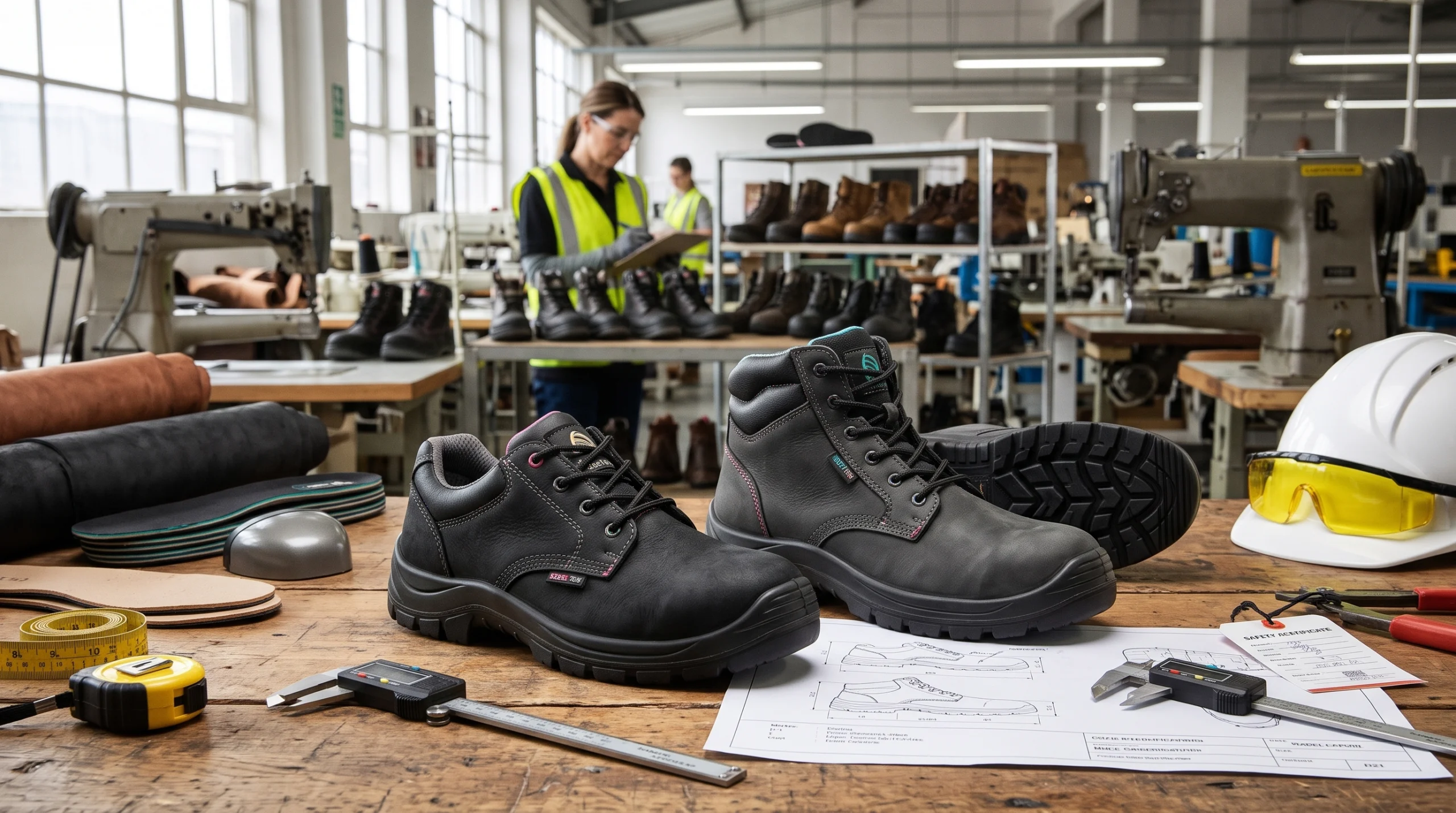
Bulk buyers sourcing women’s safety footwear face a different set of requirements than fashion shoe buyers. The product must meet workplace protection standards, pass inspection, and hold up under daily industrial use—while still fitting the female foot correctly and meeting the buyer’s cost and delivery targets. Choosing the wrong safety shoes manufacturer can result in failed compliance checks, rejected shipments, and lost contracts. Unlike fashion footwear, where a delayed order might mean a missed season, a failed safety shoe shipment can shut down a workplace safety program, trigger regulatory penalties, and damage a buyer’s reputation with employers and procurement teams. The stakes are higher, the specifications are stricter, and the margin for error is far smaller.
This guide covers what B2B buyers need to evaluate before placing a bulk order for women’s safety shoes, from certification and construction to MOQ, sampling, and quality control. It is written for procurement managers, brand owners, wholesalers, and safety equipment distributors who need a repeatable process for qualifying a factory and managing a bulk order from first brief to final delivery. You can review the women’s shoes manufacturing capabilities to see how categories, materials, and customization options are structured before requesting a quote, and use that page as a reference while you work through the evaluation steps below.
Why Women’s Safety Shoes Need a Specialist Manufacturer
Safety footwear for women is not simply a smaller version of men’s work boots. Last shapes, toe cap sizing, ankle support, and weight distribution all differ. A manufacturer that only produces men’s safety shoes will often scale down a men’s last, which leads to poor fit, discomfort, and higher return rates in the field. When a worker wears an ill-fitting safety shoe for an eight- or twelve-hour shift, the consequences go beyond discomfort: reduced concentration, foot fatigue, and in some cases a higher risk of slips and trips. For a bulk buyer, this translates into complaints from employers, replacement requests, and the cost of managing returns across a distributed workforce.
The construction of women’s safety footwear also demands different component choices. Toe caps must match the internal volume of a women’s last without creating pressure points. Outsoles need to be selected for the specific hazard profile of the workplace—whether that is slip resistance in food processing, puncture resistance in construction, anti-static properties in electronics assembly, or heat resistance in foundries. A factory that understands these distinctions can advise on the right construction before sampling begins; a factory that treats safety shoes as a single generic product will simply quote a price and produce what it has always produced.
For buyers sourcing in volume, the safer route is a factory with dedicated women’s footwear capability and experience producing protective styles. Lajwanti Collections manufactures women’s footwear across multiple categories and offers private label and OEM development, including protective and work-style constructions, through a verified process. The company has been producing footwear since 2003, which means the team has handled repeat orders, seasonal collections, and private label rollouts across a wide range of product types. Buyers who need compliance-focused work footwear should confirm the specific protection standard—for example, steel toe, composite toe, or ESD—in the brief before sampling begins, and should ask the factory to state clearly which constructions it has produced before.
What Bulk Buyers Must Verify Before Ordering
1. The Protection Standard and Test Documentation
Safety shoes are defined by their certification, not their appearance. Before ordering, confirm which standard applies to your market—such as EN ISO 20345 in Europe, ASTM F2413 in the United States, or the relevant local regulation in your destination country—and ask whether the factory can produce to that specification and supply test reports. A manufacturer that cannot state which standard it builds to is a risk. Equally, a manufacturer that claims to meet every standard without documentation should be treated with caution. Ask for the specific test reports for the components used, not just a general certificate. If the factory works with certified component suppliers, request the supplier documentation and confirm that the same components will be used in your bulk order as were used in the approved sample.
It is also worth confirming how the factory handles standard updates. Safety standards are revised periodically, and a factory that monitors these changes and updates its constructions accordingly is a more reliable long-term partner than one that works from outdated specifications.
2. Toe Cap and Sole Construction
The toe cap (steel, composite, or aluminum) and the outsole (slip-resistant, puncture-resistant, anti-static, or heat-resistant) determine the shoe’s protection class. Ask for the exact materials and whether the factory sources certified components. Composite and ESD variants often require different assembly processes, so confirm the factory has produced that construction before. Steel toe caps offer strong protection at a lower cost but add weight and can trigger metal detectors. Composite toe caps are lighter and non-metallic, making them suitable for environments where metal detection is used, but they are typically more expensive. Aluminum toe caps sit between the two in terms of weight and cost.
The outsole deserves equal attention. Slip resistance is the most common requirement in food service and healthcare, while puncture resistance matters in construction and demolition. Anti-static and ESD properties are essential in electronics manufacturing and explosive environments. Heat resistance is needed in foundries and welding shops. Ask the factory to explain how each outsole option performs against the specific hazard in your buyer’s workplace, and request test data where available.
3. Women’s-Specific Lasts and Sizing
Request the size range and confirm the factory uses women’s lasts rather than scaled men’s lasts. Ask for a size grading chart and whether half sizes are available. For bulk orders, fit consistency across sizes is a common failure point. A factory that produces a good size 38 but a poor size 42 has a grading problem, and this will show up in returns and complaints. Request samples across the size range, not just a single size, and test the fit with real wearers if possible.
Also confirm the width options. Women’s feet vary in width, and a factory that only offers a standard width may not meet the needs of buyers serving workforces with diverse foot shapes. Some factories offer multiple width fittings; ask whether this is available and what the MOQ implications are.
4. MOQ, Sampling, and Lead Time
Safety footwear usually carries a higher MOQ than fashion styles because of component sourcing. Toe caps, protective midsoles, and certified outsoles often have their own minimum order quantities from the component supplier, and these feed into the finished shoe MOQ. Confirm the minimum order quantity per design, per color, and per size run. Ask for the sample cost and timeline, and get the bulk production lead time in writing. Lajwanti Collections publishes verified MOQ and sampling timelines for women’s footwear, which helps buyers plan budgets before committing.
Be clear about what the MOQ covers. Some factories quote an MOQ per style, others per color, and others per size run. A quote that says “12 pairs MOQ” is meaningless without knowing whether that is 12 pairs total, 12 pairs per color, or 12 pairs per size. Clarify this at the quotation stage to avoid surprises later.
5. Quality Control and Pre-Shipment Inspection
Ask how the factory inspects toe cap alignment, sole bonding, stitching strength, and labeling. Safety footwear failures often appear at the sole-to-upper bond and the toe cap seat, so request the inspection checklist and confirm whether third-party inspection is allowed. A factory that resists third-party inspection is a warning sign; a professional manufacturer will welcome it because it protects both parties.
Ask for the AQL (acceptable quality limit) level the factory works to, and confirm whether the inspection is done in-house, by a third party, or both. For bulk safety footwear, a common approach is in-house inspection during production followed by a third-party pre-shipment inspection before dispatch. Confirm who bears the cost of third-party inspection and how defects are handled if they are found.
6. Compliance, Labeling, and Traceability
Safety shoes sold in regulated markets require correct labeling—the standard mark, protection symbols, size, and manufacturer details. Confirm the factory can apply your required labels and that material traceability is documented. If your buyer is subject to audit—for example, under a social compliance scheme or a customer’s supplier code of conduct—ask whether the factory can support the documentation requirements.
Traceability matters not just for compliance but for recall management. If a defect is found in a batch, the factory should be able to trace the components back to their source. Ask how material batches are recorded and whether this information can be provided with the shipment.
The B2B Ordering Process, Step by Step
A structured process reduces rejection risk on protective footwear. The steps below are a practical sequence that works for most bulk safety shoe orders, whether you are sourcing 12 pairs for a pilot or several thousand pairs for a national rollout.
Brief and standard confirmation: Submit the protection standard, toe cap type, outsole requirement, size range, quantity, and destination market. Include any labeling or packaging requirements and confirm the delivery date you need.
Feasibility and quotation: The factory confirms whether the construction is feasible and provides pricing and sample cost. This is the stage to ask questions about component sourcing, certification, and any constraints that might affect the timeline.
Paid sample development: A physical sample is produced and tested for fit, protection components, and finish. Test the sample with real wearers if possible, and check the toe cap seat, sole bond, and stitching quality.
Approval and test sign-off: You approve the sample and confirm any required test reports. Keep a signed-off sample on file; this is the reference for bulk production and for any quality disputes later.
Bulk production: Manufacturing runs against the approved sample and specification. Ask for progress updates at agreed milestones, especially if the order is large or the timeline is tight.
Inspection and shipping: Pre-shipment inspection is completed, then packing and dispatch. Confirm the shipping terms, Incoterms, and customs documentation responsibilities before the order is placed.
Each of these steps should be documented. A written record of the brief, the quotation, the approved sample, and the inspection report protects both the buyer and the manufacturer if a dispute arises.
Questions to Ask a Safety Shoes Manufacturer
Before committing to a bulk order, ask these questions directly and insist on clear answers. A reliable manufacturer will answer without hesitation; an unreliable one will deflect or give vague responses.
Which protection standard do you manufacture to, and can you supply test reports?
Do you use women’s lasts or scaled men’s lasts?
What toe cap and outsole materials do you offer?
What is the MOQ per design, color, and size run?
What is the sample cost and lead time?
Can third-party inspection be arranged before shipment?
How do you handle labeling and traceability for regulated markets?
What is the bulk production lead time, and what factors could delay it?
How do you handle defects or quality disputes after shipment?
Can you provide references or examples of similar work?
The answers to these questions will tell you more about a factory than any brochure or website.
Common Mistakes Bulk Buyers Make
Even experienced buyers make mistakes when sourcing safety footwear. The most common ones are worth knowing in advance.
Choosing on price alone. The cheapest quote often reflects lower-grade components, thinner materials, or a factory that will cut corners on inspection. Safety footwear is a protective product; price should be evaluated alongside certification and quality, not in isolation.
Skipping the sample stage. Some buyers approve a sample quickly to save time, then discover problems in bulk production. The sample is your only opportunity to catch fit, construction, and finish issues before they are replicated across the entire order.
Not testing across sizes. A single sample size tells you very little about grading. Request samples across the size range and test the fit before approving.
Ignoring labeling requirements. A shoe that meets the protection standard but carries the wrong label cannot be sold in a regulated market. Confirm labeling requirements early and check the labels on the sample.
Failing to document the approval. Verbal approvals and email threads are not enough. Keep a signed-off sample and a written specification, and reference both in the purchase order.
Working with Lajwanti Collections
Lajwanti Collections is a direct B2B manufacturer based in Lahore, Pakistan, producing women’s footwear for brands, wholesalers, and retailers. The company offers private label and OEM development with verified MOQ and sampling timelines, and supports buyers who need protective and work-style constructions alongside its fashion categories. Because the factory handles core operations in-house and works with trusted specialist vendors for selected processes, it can maintain quality control while offering a wide range of finishes. An NDA is available on request for buyers who need to protect proprietary designs.
To discuss a bulk safety footwear project, start by reviewing the women’s shoes manufacturing and submitting your product brief with the required protection standard. The more detail you provide at the brief stage—standard, toe cap type, outsole requirement, size range, quantity, labeling, and delivery date—the faster the factory can confirm feasibility and provide a quotation.
Conclusion
Sourcing women’s safety shoes in bulk is a process, not a transaction. The buyers who get reliable results are the ones who verify the protection standard, confirm the construction, test the fit across sizes, document the sample approval, and inspect before shipment. A manufacturer that supports this process—with clear communication, verified MOQ and timelines, and a willingness to accommodate inspection—is worth more than a lower quote from a factory that cuts corners.
Lahore has the manufacturing base and the skilled workforce to produce quality women’s safety footwear. The key is choosing the right partner and following a structured evaluation process. With the steps outlined in this guide, bulk buyers can reduce risk, avoid rejected shipments, and build a supply relationship that holds up over repeat orders.
FAQs
What is the MOQ for women’s safety shoes?
MOQ depends on the construction, toe cap type, and component sourcing. Safety footwear usually carries a higher MOQ than fashion styles because toe caps, protective midsoles, and certified outsoles have their own minimum order quantities from component suppliers. Lajwanti Collections publishes verified MOQ details for women’s footwear; confirm the exact figure for your design before ordering, and clarify whether the MOQ applies per style, per color, or per size run.
Can you manufacture to EN ISO 20345 or ASTM F2413?
Confirm the target standard in your brief. The factory will state whether it can produce to that specification and what test documentation it can supply before sampling. Ask for component-level test reports, not just a general certificate, and confirm that the same components used in the approved sample will be used in the bulk order.
Do you use women’s-specific lasts?
Yes—women’s footwear is produced on women’s lasts rather than scaled men’s lasts, which improves fit and reduces field return rates. Ask for the size grading chart and request samples across the size range, not just a single size, to confirm grading consistency before approving the order.
How long does sampling and bulk production take?
Sampling and bulk timelines are confirmed at quotation stage and depend on the construction and components. Request the timeline in writing before committing to a bulk order, and ask for progress updates at agreed milestones during bulk production.
Can I request third-party inspection?
Third-party pre-shipment inspection can be arranged; confirm this at the quotation stage so it is built into the production schedule. Ask who bears the cost of inspection and how defects are handled if they are found. A professional manufacturer will welcome third-party inspection because it protects both parties.
What labeling is required for safety shoes?
Labeling requirements depend on the destination market and the applicable standard. Safety shoes typically require the standard mark, protection symbols, size, and manufacturer details. Confirm the labeling requirements for your market early in the process and check the labels on the approved sample before bulk production begins.
How do you handle defects or quality disputes after shipment?
Ask this question before placing the order. A reliable manufacturer will have a documented process for handling defects, including how claims are assessed, who bears the cost of replacement or repair, and what timeline applies. Get the process in writing as part of the purchase order terms.