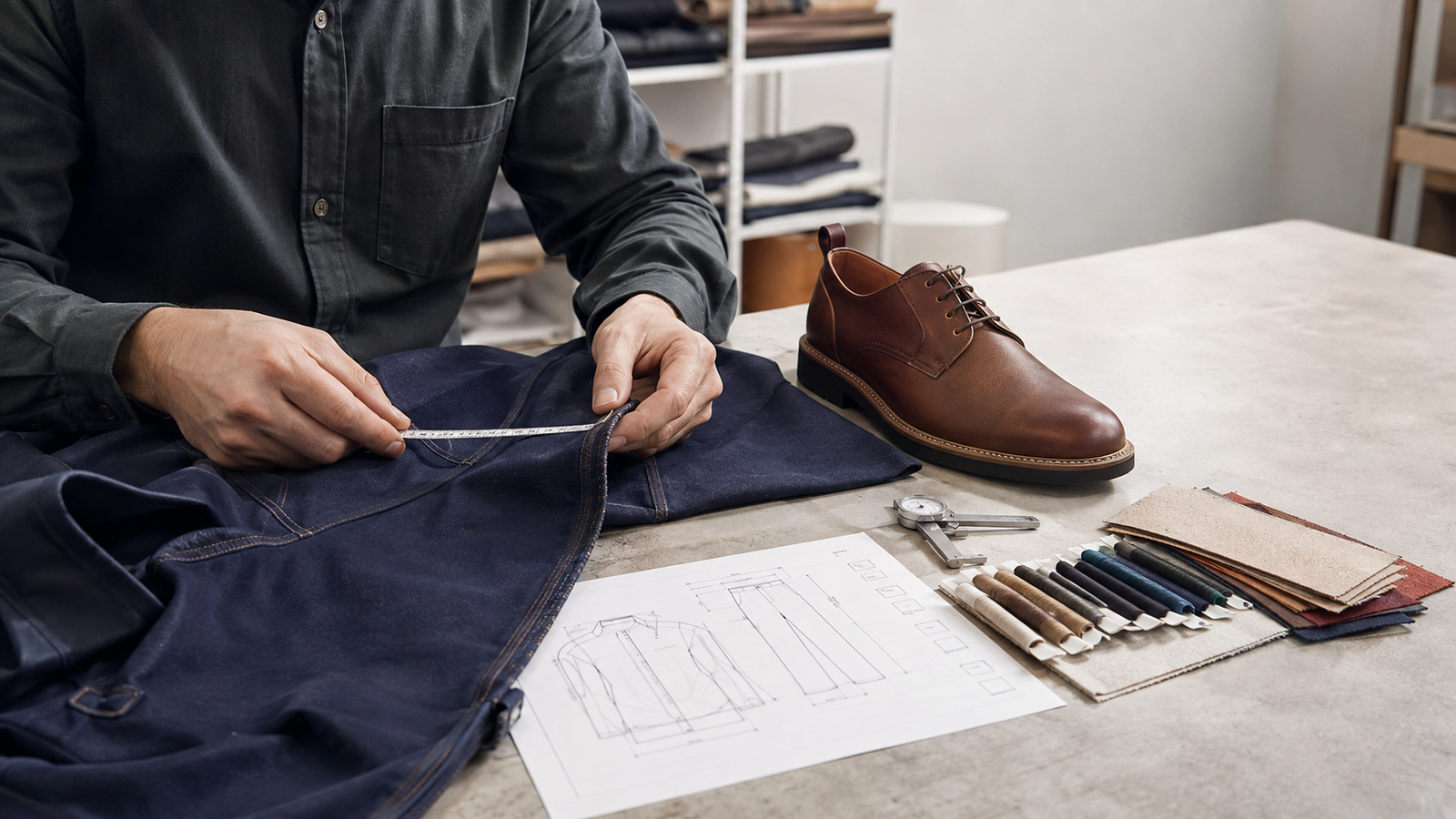
A good sample starts with good supplier screening. Before sending money, confirm that a manufacturer understands your product, can explain its process clearly and is willing to put important details in writing.
If you are learning how to vet a clothing manufacturer or footwear supplier, do not rely on polished photographs, a low quotation or quick replies alone. Use the 21 questions below to compare candidates on the same evidence. The aim is not to find a manufacturer that says yes to everything. It is to find one whose capabilities, terms and communication fit your project.
Prepare a Clear Product Brief First
Supplier answers are only useful when every candidate receives the same brief. Share the product type, target materials, construction, sizes, colourways, branding, packaging, estimated quantity and destination country. Add drawings, reference images or a tech pack if available. This manufacturing-enquiry checklist shows the practical details a supplier needs to review feasibility, sampling and quotation requirements.
Separate must-have requirements from preferences. Ask each supplier to identify anything unclear before quoting. This makes prices easier to compare and reveals whether the team reviews specifications carefully.
21 Questions to Ask a Clothing or Footwear Manufacturer
Product Fit and Manufacturing Scope
1. Do you regularly manufacture this product type?
Ask for relevant, non-confidential examples. Experience with basic T-shirts does not automatically prove capability in technical sportswear, structured jackets or complex footwear. Compare the claimed specialism with the supplier’s actual product categories, such as its custom apparel manufacturing options.
2. Which operations do you handle directly?
Clarify who handles pattern or last development, cutting, stitching, assembly, finishing and packing. Also ask which processes are outsourced, such as printing, embroidery, sublimation, washing or specialist components.
3. Can you develop from my current files?
Confirm whether the supplier can work from a tech pack, sketch, photograph, reference sample or mood board, and what additional information it needs.
4. Who will manage my project?
You need a clear contact for specifications, sample comments, approvals and production updates.
Materials and Customization
5. How will you source and approve materials?
Ask how fabric, leather, trims, soles, hardware and packaging will be identified. Request swatches or component options where appearance or performance matters.
6. Can you match colours, sizes and measurements?
Agree on the colour reference system, measurement chart, tolerances and grading method before sampling.
7. What branding and packaging options are available?
Discuss labels, logos, prints, embroidery, hardware, boxes, bags and barcodes. Confirm setup charges and minimums for each element.
8. Can you provide documentation for a required material or claim?
If your market or specification requires certified, recycled or performance materials, ask what documentation is available and who holds it. Never treat a general statement as proof.
MOQ, Sample and Pricing
9. What is the MOQ for this exact specification?
Ask whether the minimum applies per design, colour, size, material or logo. A headline MOQ may change once custom components are added.
10. What does the sample fee include?
Confirm whether the price covers materials, patterns or lasts, tooling, branding, packaging, revisions and shipping. Ask which charges are non-refundable.
11. How many sample revisions are included?
Define how comments will be recorded, what counts as a new sample and how extra revisions are priced.
12. What is the sample timeline, and when does it begin?
The clock should start only after specifications, materials and payment are confirmed. Separate development time from courier transit.
13. Will the approved sample and specification control bulk production?
Ask how approval is documented and how later changes affect price, timing and quality.
14. Can you provide an itemized quotation?
The quote should identify the product specification, quantity, unit price, sample or tooling charges, packaging, freight basis, currency, validity and exclusions.
Quality, Production and Compliance
15. What quality checks take place before shipment?
Look for specific checks covering materials, measurements, stitching, decoration, finishing and packing—not a vague promise of “high quality.” The ISO explanation of quality assurance and quality control is useful here: quality assurance focuses on processes that reduce defects, while quality control checks whether those processes produced the required result.
16. What tolerances and acceptance criteria will we use?
Record acceptable variation in measurements, colour, placement and workmanship. Decide how defects, rework and replacements will be handled.
17. How do you control subcontracted work?
Ask who selects and checks outside processors and whether subcontracting can change without notice.
18. Which labels, tests or documents does my destination market require?
The buyer remains responsible for confirming applicable rules, but a capable supplier should discuss required inputs. For example, the U.S. Federal Trade Commission’s textile-labelling guidance explains that many textiles sold in the United States require fibre content, country-of-origin and business-identity labelling, while care instructions may also apply.
19. What is the production lead time after sample approval?
Request a realistic range and the factors that can change it, including material availability, quantity, decoration, packaging and production scheduling.
Commercial Terms and Verification
20. What are the payment, confidentiality and ownership terms?
Confirm payment method, currency, due dates, bank charges, design confidentiality, tooling ownership and whether an NDA is available before sharing sensitive files.
21. How can I verify the business and shipment arrangements?
Request the legal business name, invoice details, operating location and a live video call or independent inspection where risk justifies it. Confirm shipping terms, tracking, insurance, export documents, duties and who is responsible at each stage. The U.S. International Trade Administration recommends performing due diligence on a potential foreign business partner; for higher-value international orders, consider a formal third-party background check.
Score Each Manufacturer Before Choosing
Use a simple 0–2 score for every question:
- 0: no answer, inconsistent answer or unsupported claim
- 1: partial answer that needs clarification
- 2: clear, relevant answer supported by documents, samples or an agreed process
The maximum is 42. Do not select a supplier on the total alone. Treat unclear payment identity, refusal to document specifications, pressure to pay immediately, unverifiable certificates, changing bank details or unwillingness to define quality criteria as serious warning signs.
Shortlist the strongest candidates, verify critical claims, and then purchase one paid sample. A sample tests more than the product: it also shows how the supplier interprets instructions, reports problems, manages revisions and meets agreed checkpoints.
What to Put in Writing Before Paying
Before making a sample payment, keep one written record containing:
- final sample specification and reference files;
- materials, colours, measurements and branding;
- sample price, inclusions and revision terms;
- development timeline and shipping method;
- approval criteria and next steps;
- payment recipient and invoice details;
- confidentiality and tooling terms, where relevant.
If you are comparing a footwear or apparel project with Lajwanti Collections, review the company background and manufacturing position. Lajwanti Collections offers paid sample development for B2B projects; the exact MOQ, sample schedule and production timing depend on the category and approved specification. When your brief is ready, discuss the project with the manufacturing team on WhatsApp.
Frequently Asked Questions
How do I verify a clothing manufacturer?
Confirm its legal identity and operating location, hold a live call, review relevant work, check documents independently and compare invoice and payment details. For a higher-risk overseas order, consider a third-party company check or site inspection.
Should I pay for a clothing sample?
Paid samples are normal in custom manufacturing because they require materials, development and labour. Confirm what the fee includes, how revisions work and whether shipping is separate before paying.
What is a reasonable clothing manufacturing MOQ?
There is no universal MOQ. It varies by product, material, colour, branding, component minimums and production method. Ask for the minimum for your exact specification, not a general starting figure.
Does a good sample guarantee good bulk production?
No. The approved sample should become the production reference, but you still need written specifications, tolerances, in-process controls and final inspection criteria.
Final Takeaway
Learning how to vet a clothing manufacturer is mainly about replacing assumptions with evidence. Give every supplier the same brief, ask the same 21 questions, document the answers and verify the points that could affect quality, cost or delivery. Then use a paid sample as a controlled test before committing to bulk production.